Long list
Twenty to fifty candidates against your criteria, with the key fields on each line. If the grid turns out wrong, a second pass doesn't need a new engagement.
€500per search grid

TACTIC SME Radar
Anyone looking for a succession deal or a bolt-on finds, on the usual platforms, the companies that are already in a competitive process. The SME Radar works upstream of that: it identifies German mid-sized candidates from public sources and delivers one dossier per company, in which every claim carries its source and the date it was retrieved.
The problem
Pulling candidates together, checking registers, reading websites, working out who owns what, discarding the misses — and then doing all of it again, in depth, for the names that survive. Done in-house, that ties up several days, and what comes out is a document somebody has to put their name to.
Fictional example
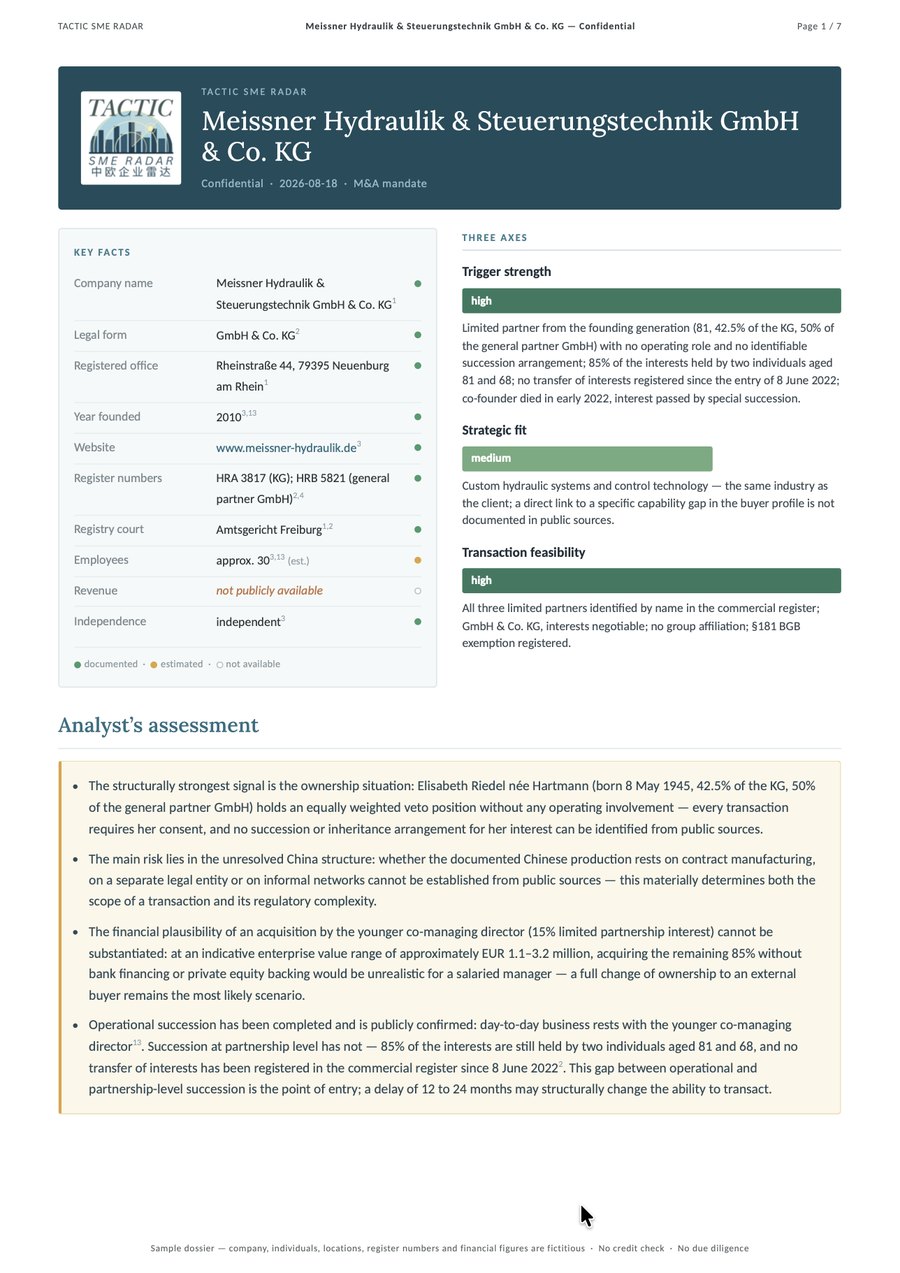
A dossier runs to roughly six to eight pages depending on the case. The structure never changes, so that several candidates can be laid side by side and ranked.
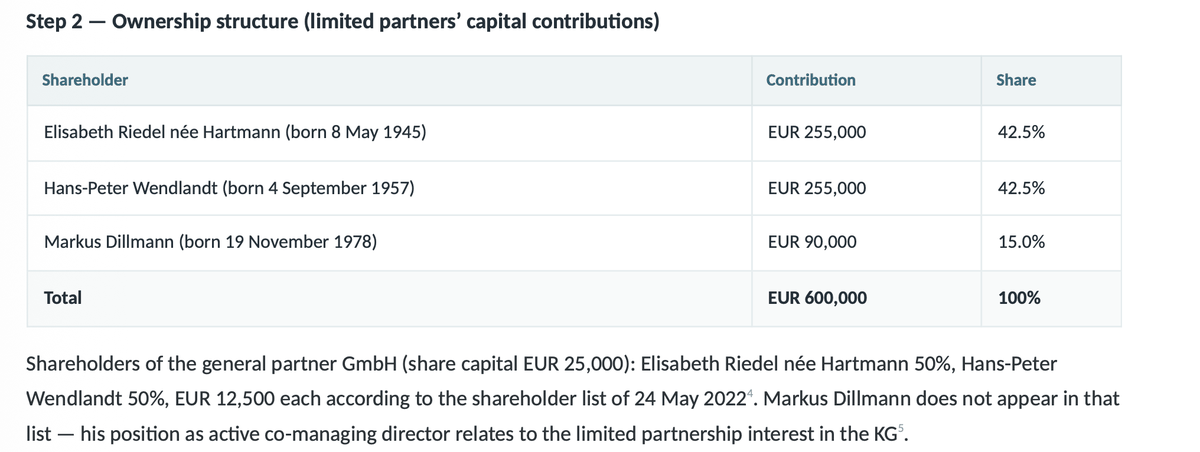
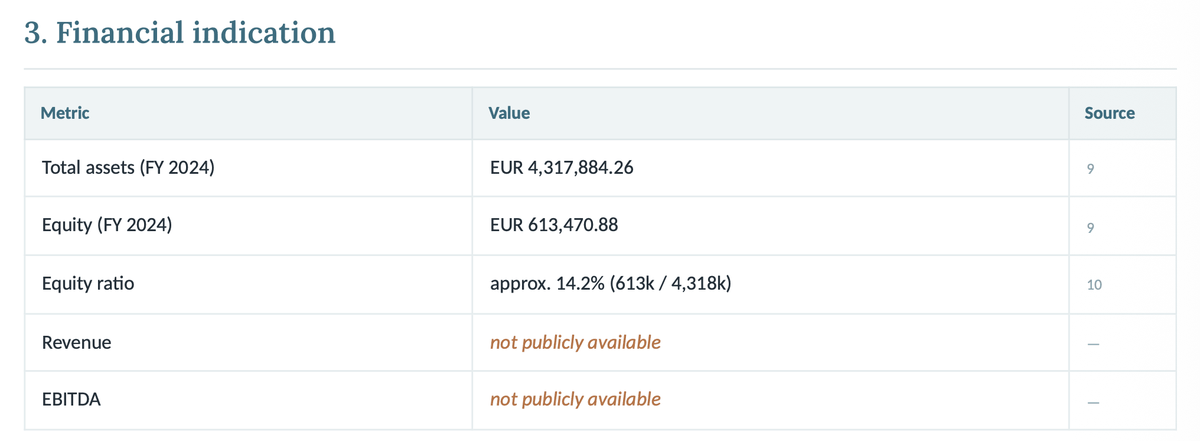
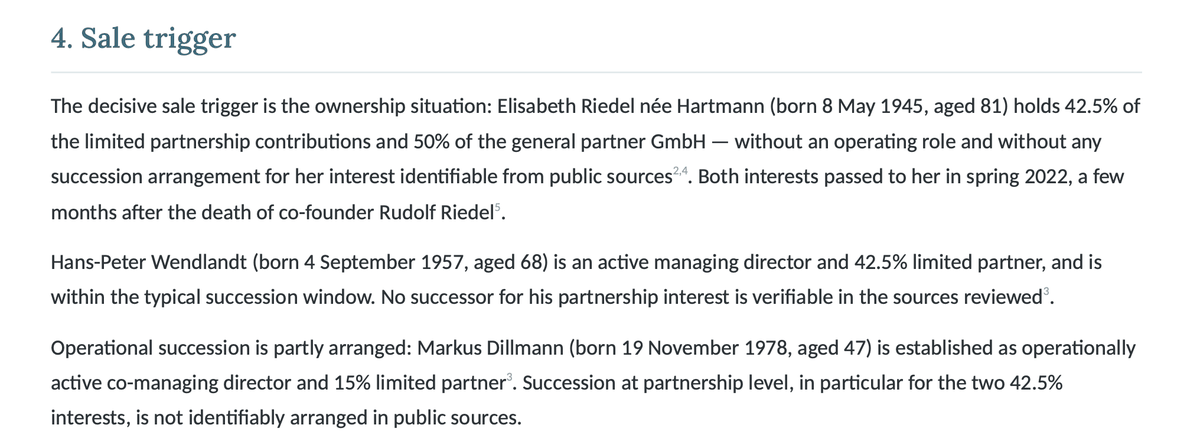
What this sample can and cannot show you. The company, people, locations, register numbers and figures in this sample dossier are invented; any resemblance to real companies or people would be coincidental. What you can judge from it is the structure: which fields appear, how each claim is evidenced, and how the assessment is kept separate from the register facts. Whether the substance holds up is something an invented case cannot demonstrate — that is what the trial dossier on a real company is for.
Where this differs
A language model will also produce a document. Six differences that matter once you are on a mandate.
Who holds what, who can block a transaction, where the majority sits. These come from the commercial register and the notarised shareholder list — public, but retrievable only one company at a time and by hand.
A language model cannot reach these documents at all.
A ten per cent holding, a salaried managing director, a business worth millions — together these mean an external buyer is the most likely outcome. Making that connection is what the method is for.
A language model finds isolated public fragments but does not combine them into a statement about the transaction situation.
Every report has the same summary, the same chapters, the same three axes. The format is fixed rather than reinvented case by case.
A language model structures every text differently and will assess the same case differently on two identical prompts.
Where revenue has not been published, the report says so — the figure is not estimated and not substituted from comparables.
A language model does not distinguish between a figure that is evidenced, one that is estimated, and one that is several years old.
Register facts sit in one section, the assessment in another, inferences with the chain behind them. You can see what is evidenced and what is concluded.
A language model blends the two into continuous prose, and both read equally confident.
Each source records when it was pulled. You can see how current a register entry is and when it should be refreshed.
A language model gives no date — you cannot tell whether something is from yesterday or from a training set three years old.
Method
Sector and region, down to the federal state, district or town, plus size band and exclusion criteria.
The search returns a raw list by sector and region. Headcount and size are not in it yet — I work through that list and strike out what is too large, too small or otherwise off-grid. What you get is a reviewed list, not a raw export.
You decide which companies justify a dossier — typically three to five. Only then does the deep work start.
The register extract, shareholder list and annual accounts are public, but retrievable only one at a time and by hand — the registers block automated access. Accounts have been filed with the German Company Register (Unternehmensregister) since fiscal year 2022; earlier years remain in the Federal Gazette (Bundesanzeiger). On top of that come the company's own website, trade press and regional coverage. Anything that doesn't surface there, I chase down separately before the report is written.
Not a data sheet, but a view: what argues for an approach, where the best entry point sits, and which question to settle first. It rests on the register and accounts plus whatever the research adds — the fuller the basis, the more the judgement carries.
That judgement always takes the same form: three axes, each with a written rationale rather than a score. It is what makes it possible to lay several candidates side by side and rank them.
One revision is included. If you already know the company, or hold documents that are not publicly findable, I work those in — the revised version is usually back with you within one working day.
How the assessment looks in the sample dossier — a rationale per axis, no overall score.
Deliverables
You commission what the mandate actually needs and receive finished dossiers you can put in front of your client — under your own letterhead if you prefer. All prices net; as a Polish company I invoice under the reverse charge procedure.
Twenty to fifty candidates against your criteria, with the key fields on each line. If the grid turns out wrong, a second pass doesn't need a new engagement.
Roughly six to eight pages per company, structured as in the sample above. Three to five dossiers per mandate is typical, and one revision is included.
German and English as standard, Chinese on request for mandates involving Chinese buyers.
Where the buyer or client sits in China: approach, coordination and ongoing correspondence in Chinese, in your name. Available independently of any dossier.
The obvious objection
True. Fifteen pages, twenty sources, instantly and for nothing. You will check both — anything else would be negligent. The only question is how long that takes.
With a report that carries no evidence chain, you have to open all twenty sources yourself, because you cannot tell in advance which claim holds and which merely sounds plausible. With a dossier that carries a source and a retrieval date on every line, you check three of them and you know whether the rest holds.
Volume got cheap. Evidence did not. What a language model cannot deliver is the documents behind the register counter — and someone who puts their name to the conclusion.
Gathering the documents is quick. The time goes into reading and writing: reconstructing the ownership split, putting the figures in context, evidencing every claim, drafting the case. At what hourly rate that pays off, you'll work out faster than I will.
Fit
Handling of data
Shareholders and managing directors appear by name — there is no other way to set out an ownership position. That is precisely why what belongs in the report, and what does not, is fixed in advance.
The SME Radar is not a product you operate. There is no third-party access and no way to generate reports yourself. I run every search personally and stand behind what ends up on the page.
The basis is the commercial register, the shareholder list, annual accounts, the company's own website and the press. Details about individuals appear only where they are on the register or already published and relevant to the ownership question. Nothing from social networks, data brokers or private life.
The report attributes no intentions and names no presumed heirs. It sets out documented circumstances — the ownership position, the age of an entry, the absence of a visible succession arrangement. Where it draws a conclusion from them, that conclusion is labelled as an assessment, with the chain behind it.
Contact
The sample above shows the structure. Whether the substance holds up can only be shown on a real case. So give me the sector, region and size band of a grid you are working on anyway. You'll get a full dossier on one company — with real register entries, real sources, real retrieval dates. Check three lines, and you'll know whether the method holds.

Fabian Maier · TACTIC Asia Europe Consulting Sp. z o.o., ul. Łostowicka 29, 80-121 Gdańsk, Poland